Government, CMU, and SEI Leaders Celebrate 40 Years of Advancing Software for National Security
• Article
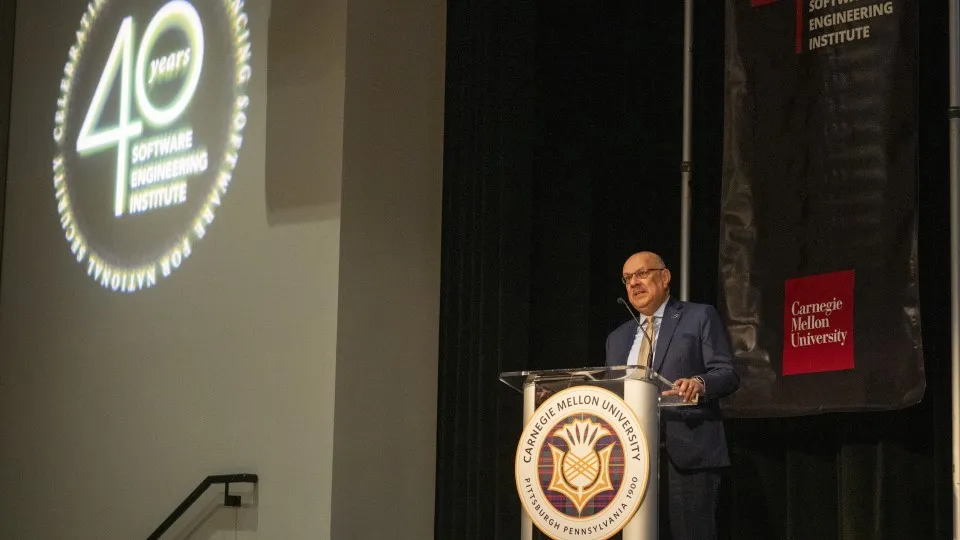
September 8, 2025—Carnegie Mellon University (CMU) President Farnam Jahanian and other leaders from the university, the federal government, and the CMU Software Engineering Institute (SEI) gathered Sept. 4 to commemorate the SEI’s 40 years of advancing software as a strategic advantage for national security. Since beginning operation in 1985, the SEI has been at the forefront of technology transformations that have changed how the Department of Defense (DoD) provides capabilities and protects its systems and networks. Speakers at the event held on the CMU campus reflected on the institute’s origins, its impact on the nation’s defense, and coming opportunities for innovation.
Addressing an audience of SEI researchers, government partners, and CMU faculty and staff, Jahanian noted the prescience of the SEI’s establishment. “Forty years ago, the DoD grew its partnership with CMU, driven by the foresight that reliable and secure software would play a defining role in supporting national defense and national security. It was way ahead of its time.”
Though SEI director and chief executive officer Paul Nielsen was not involved in the SEI’s establishment, he told the audience that in the mid-1980s, as an Air Force officer focused on software-intensive programs, he saw the need for a federally funded research and development center (FFRDC) for software. He praised the university’s leadership at the time, President Richard M. Cyert, provost Angel Jordan, and School of Computer Science faculty, for helping win the original contract for the SEI. “Many FFRDCs did not start with competition, but we really started with competition against other universities,” Nielsen said.
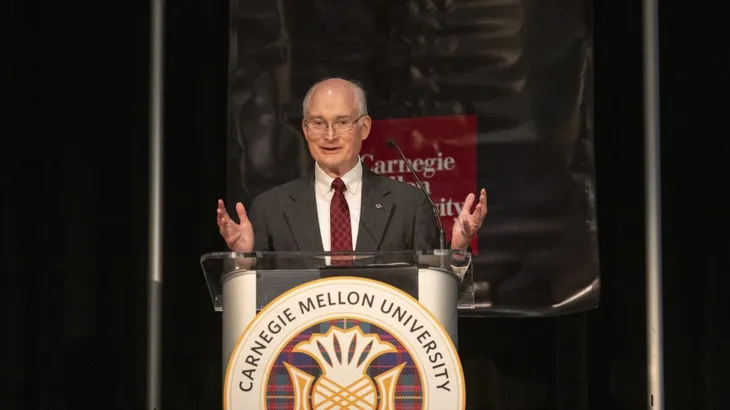
Paul Nielsen
He went on to speak about the impact of the SEI’s people, noting that the institute initially employed just 15 staff, a number that has grown to more than 600. Beyond their work at the institute, past and current SEI researchers have strengthened the technology and engineering communities through service in professional societies and on government boards and panels. A number of researchers have also transitioned to leadership roles within the government or gone on to work in industry. Nielsen referred to countless journal articles and conference presentations by SEI experts and more than 100 books, the first of which was the influential Managing the Software Process, by National Medal of Technology and Innovation winner Watts Humphrey.
The DoD’s Michael J. Holthe, performing the duties of assistant secretary of defense for science and technology, commented on how CMU and the DoD have created a technology ecosystem in Pittsburgh that benefits the American military and beyond. “With software central to modern warfare, from weapon systems to communications and intelligence, SEI offers our warfighters the secure, high-quality software systems they can rely on,” he said. “SEI’s legacy of innovation and leadership continues to be vital for ensuring our collective digital future.”
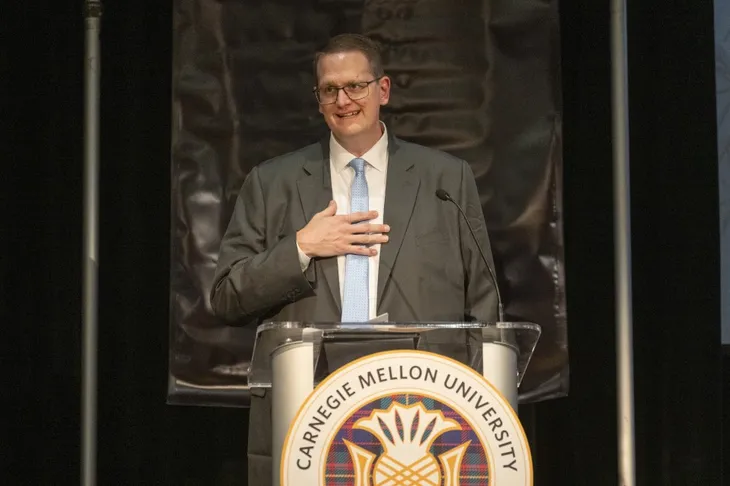
Michael J. Holthe
The program concluded with a panel discussion on the SEI’s history, milestones, achievements, and future, moderated by Theresa Mayer, CMU’s vice president for research. She noted that the SEI’s 40th anniversary comes as CMU celebrates its own milestone: 125 years of education, innovation, and transformation. “The collaboration between SEI and the academic campus continues to set us apart and remains as strong as ever,” said Mayer. “As we look into the future, there are even greater opportunities for us to come together in ways that we haven't before.”
Panelists included David Morrison, former House defense appropriations staff director and former deputy associate director of the Office of Management and Budget for national security; John Gilligan, head of the SEI Board of Visitors and president of the Center for Internet Security; Anita Carleton, SEI Fellow and director of the SEI’s Software Solutions Division; and William Scherlis, CMU professor of software and societal systems and special advisor to the director of the SEI.
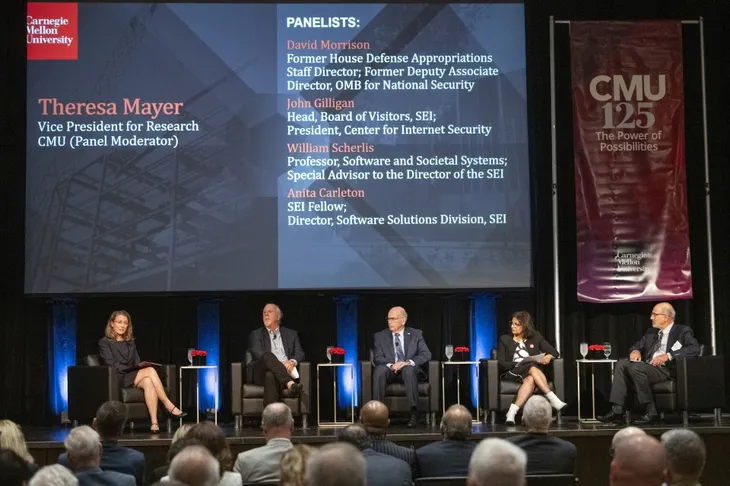
Theresa Mayer, left, hosts a panel discussion featuring David Morrison, John Gilligan, Anita Carleton, and William Scherlis.
The DoD established the SEI as an FFRDC in 1984, and the institute began operations in early 1985. Early on, the SEI evolved the Capability Maturity Model Integration (CMMI), a framework for assessing an organization’s software process maturity. Following the Morris worm attack in 1988, the SEI became a leader in incident response, vulnerability analysis, and cybersecurity research. The SEI led a third key technology transformation, this time in software architecture, particularly through creation of the Architecture Analysis and Design Language (AADL). In the last decade, the SEI has advanced an Artificial Intelligence (AI) Engineering discipline and an AI system development lifecycle. The SEI remains the DoD’s only FFRDC focused on software.
“What a joy it’s been to work all these years with the men and women of the SEI,” said Nielsen. “To work with our sponsors and customers, who are such dedicated professionals. To support the soldiers, sailors, airmen, Marines, and guardians and all they do for our nation. And to be such an integral part of the Carnegie Mellon and Pittsburgh communities.”
Jahanian pointed to the SEI’s contract renewal with the Defense Department in June as evidence of the government’s ongoing commitment to the institute. “The SEI will continue working in lockstep with the DoD to develop the technologies and practices needed to support our nation's critical infrastructures and priorities,” he said. “It's against this backdrop that we find ourselves celebrating 40 years of history-making advances, and all of us are looking forward to continued impact in the years to come.”
Watch the video of the SEI’s 40th anniversary speakers, and learn more about the SEI’s history of advancing software for national security.
Photos: Kevin Lorenzi, CMU Photography