Supporting DARPA’s AI Reinforcements: Tactical Autonomy AI for Future Air Combat
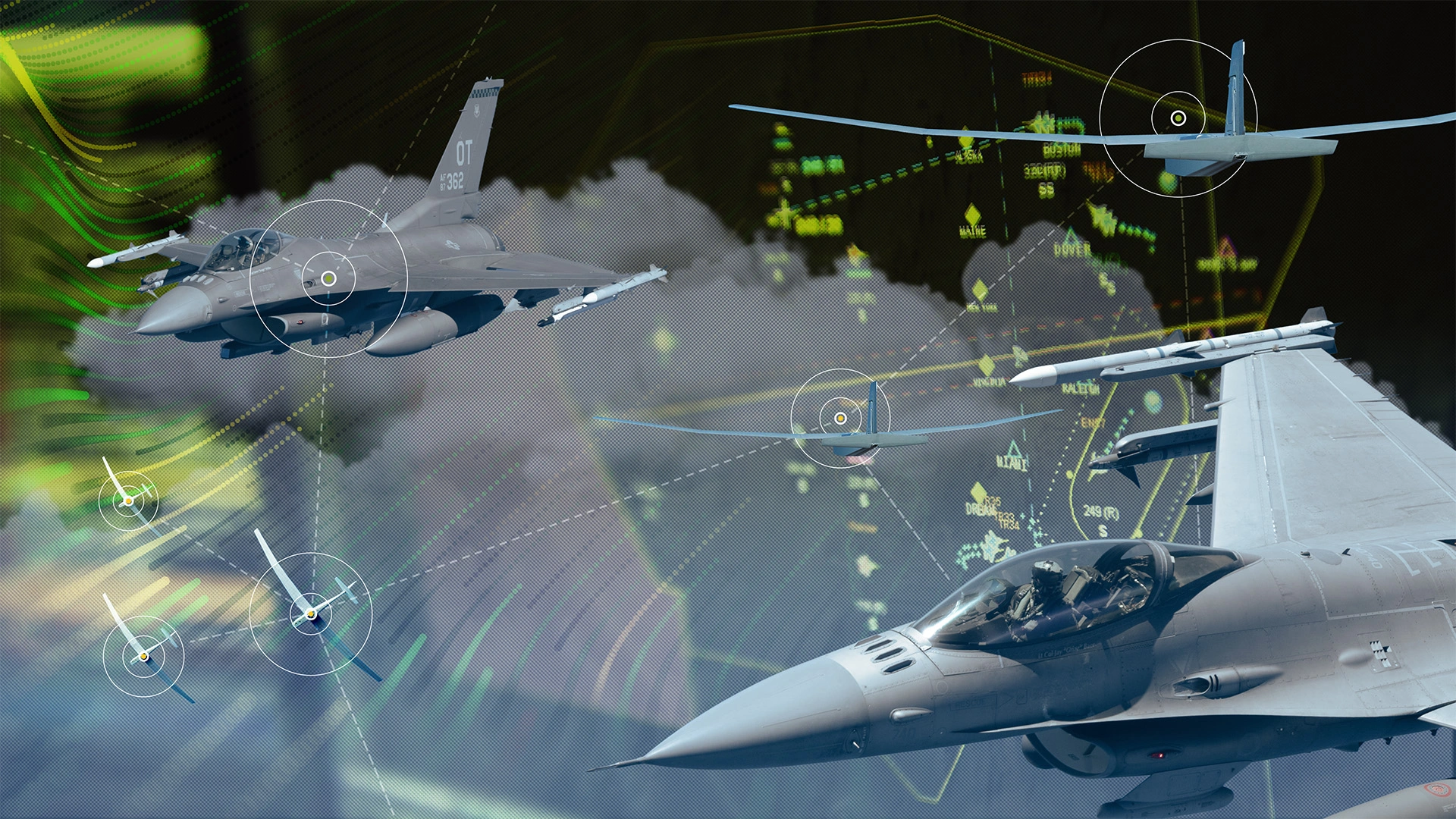
Autonomous air combat faces technical challenges, such as sensor integration, scalability, adaptability to open-world conditions, and the ability to make predictions with uncertain knowledge. While the Defense Advanced Research Projects Agency’s (DARPA) Air Combat Evolution (ACE) program developed autonomous approaches for within-visual-range (WVR) combat, its Artificial Intelligence Reinforcements (AIR) program focuses on beyond-visual-range (BVR) combat. The Software Engineering Institute is working with DARPA to develop and evaluate industry performer solutions for BVR air combat under real-world conditions.
The goal of DARPA’s AIR program is to develop AI-driven tactical autonomy for multi-ship, BVR air combat missions. DARPA, an independent research and development agency within the U.S. Department of War (DoW), created the AIR program to advance American warfighters’ tactical advantage while significantly decreasing their risks.
The SEI has been a partner on the AIR program since before its official kickoff in February 2024. Its role is to build and run the development and test and evaluation (T&E) infrastructure that industry performers and DARPA need to create and evaluate AI solutions.
An automated DevSecOps pipeline that allows for seamless continual collaboration and integration is key to success.
Senior Software Engineer, SEI Software Solutions Division

Pipeline to Innovation
A DevSecOps pipeline was one of the first things the AIR program needed. “DARPA is working with a distributed team of hundreds of developers across multiple government agencies and third-party organizations,” said Kevin Pitstick, a senior software engineer and the SEI’s lead on the AIR program. “An automated DevSecOps pipeline that allows for seamless continual collaboration and integration is key to success.”
Pitstick and his team applied software engineering principles in the development and implementation of an automated DevSecOps pipeline designed for reusability. The pipeline incorporates such best practices as integrated testing, security scanning, and consistent release versioning.
Critically, the pipeline allows all developers and performers within DARPA AIR to focus exclusively on innovation and development by abstracting away the typical complexity and distraction of maintaining a continuous DevSecOps environment. The pipeline’s unique design not only supports unclassified development flows but also transitions seamlessly and securely to the Secret Special Access Program (SAP) environment. This minimal disruption to the development workflow maintains the velocity of technological advancement, directly enhancing the AIR program’s ability to achieve its objectives with speed and security.
Test and Evaluation
The SEI’s development and implementation of a T&E framework allows automated testing of performer solutions both locally during development and in a production leaderboard. DARPA evaluators can identify the most successful AI agents by comparing metrics and replays from simulation runs. The SEI’s approach has focused on reproducibility of test results, configuration-as-code for all evaluation setups, and automation of the testing process.
In the time since the T&E framework has been implemented, the SEI has designed, implemented, and run more than 15 challenge cycles with a combined total of almost 300,000 simulation runs with industry performer models and agents. By using the data from the automated evaluation results, DARPA is able to trace the results to each agent, assess the agents developed, and identify the ones that will move forward for further development, testing, and ultimately integration into live flight testing.
Partnering for Mission Success
Developing AI systems that are trustworthy and can support complex, multi-ship air combat missions is an unprecedented challenge. The SEI has long-standing experience in software engineering, secure development practices, and the rigorous application of the DevSecOps methodology. By leveraging this expertise, the SEI equipped the DARPA AIR program with a robust, secure, and highly efficient pipeline, allowing them to rapidly accelerate development while maintaining the highest possible security standards from day one.
Photo illustration: Christopher Baum, artist's concept.
Photo illustration: U.S. Air Force photo by Hun Chustine Minoda (planes). U.S. Coast Guard photo by Petty Officer 3rd Class Roberto Nieves (drones). U.S. Air National Guard photo by Shane Hughes (airspace).
This research was developed with funding from the Defense Advanced Research Projects Agency (DARPA). The views, opinions, and/or findings expressed are those of the author(s) and should not be interpreted as representing the official views or policies of the Department of Defense or the U.S. Government.
Distribution Statement "A" (Approved for Public Release, Distribution Unlimited)
Principal Investigator
Kevin Pitstick (DARPA AIR)
John Wohlbier (DARPA MOCHA)
Researchers
Brandon Born, Patrick Earl, Keaton Hanna, Aaron Reuter (DARPA AIR)
Drew Dolgert, Ryan Steele, Derek Gobin (DARPA MOCHA)
Read More
Warfighter-AI Partnership: Beyond Humans in the Loop
SEI chief technology officer Tom Longstaff projects the steps needed for contextual AI to provide tactical warfighting advantage.
Automation Speeds Up Quality Assessments for Safety-Critical Software
The SEI creates automated tools for assessing code quality and risk, even for the most sensitive national security programs.