AI Adoption Maturity: Improving How Organizations Integrate AI Solutions
Created June 2026
Fast-evolving advances in artificial intelligence (AI)—particularly in generative AI technologies and agentic AI implementations—have challenged organizations to rethink how they conduct business. An important step in resolving AI adoption challenges is to treat adoption as a rigorously managed process toward institutionalization—one that can be systematically scaled, measured, and optimized through clearly defined intermediary objectives while being nimble in establishing disciplined practices. Success is defined by the ability to make progress along a well-defined roadmap and continuous improvement rather than by governed practice. As part of its efforts to help organizations address AI challenges, the Software Engineering Institute (SEI) partnered with Accenture to develop the AI Adoption Maturity Model. This model provides organizations with a comprehensive, research-backed, and tested framework to guide their AI adoption journeys with confidence. The model enables organizations to measure the degree to which essential practices are implemented and governed, ensuring they can adapt and deliver AI solutions that meet business needs with predictable, repeatable outcomes. Its purpose is to drive the creation of a clear, actionable roadmap based on an assessment of organizational maturity.
Are You Prepared to Adopt AI Solutions That Deliver the Value You Expect?
The gap between the expected and realized value that organizations gain from implementing AI remains significant, and AI adoption failures rarely stem from the technology alone. More often, they arise from mismatched expectations, misaligned use cases, insufficient data capabilities, lack of user understanding, talent shortages, and underestimation of time commitments, especially for establishing and following repeatable processes. To deliver value and return on investment amid these challenges, organizations must identify the right workflows they should reenvision with AI and the key indicators they should measure to assess progress. In addition, organizations must establish the capabilities needed to measure progress and success and strengthen the skills required to scale solutions across their enterprise or through their desired organizational scope.
Our Collaborators
To address these problems, the SEI partnered with Accenture—a global leading services and solutions company driving AI-enabled reinvention—to develop the AI Adoption Maturity Model. Accenture contributed its extensive global experience in implementing AI technology and deep industry expertise to help identify goals and practices that are necessary for effective AI adoption.
Adopt AI with Greater Confidence
The SEI developed the AI Adoption Maturity model to pave a decisive way forward for organizations to adopt AI. To create it, the SEI conducted interviews with more than two dozen executives, surveys of nearly one thousand practitioners, and reviews of over one hundred existing AI maturity efforts worldwide. The result of this work enables organizations to align their AI efforts with business priorities and achieve repeatable, scalable success across their enterprises.
By emphasizing evidence-based measurement, the model empowers organizations to realize sustained value from their AI investments and target the capabilities that will deliver the greatest impact. To accomplish these outcomes, the model defines eight core organizational change and system lifecycle engineering dimensions.
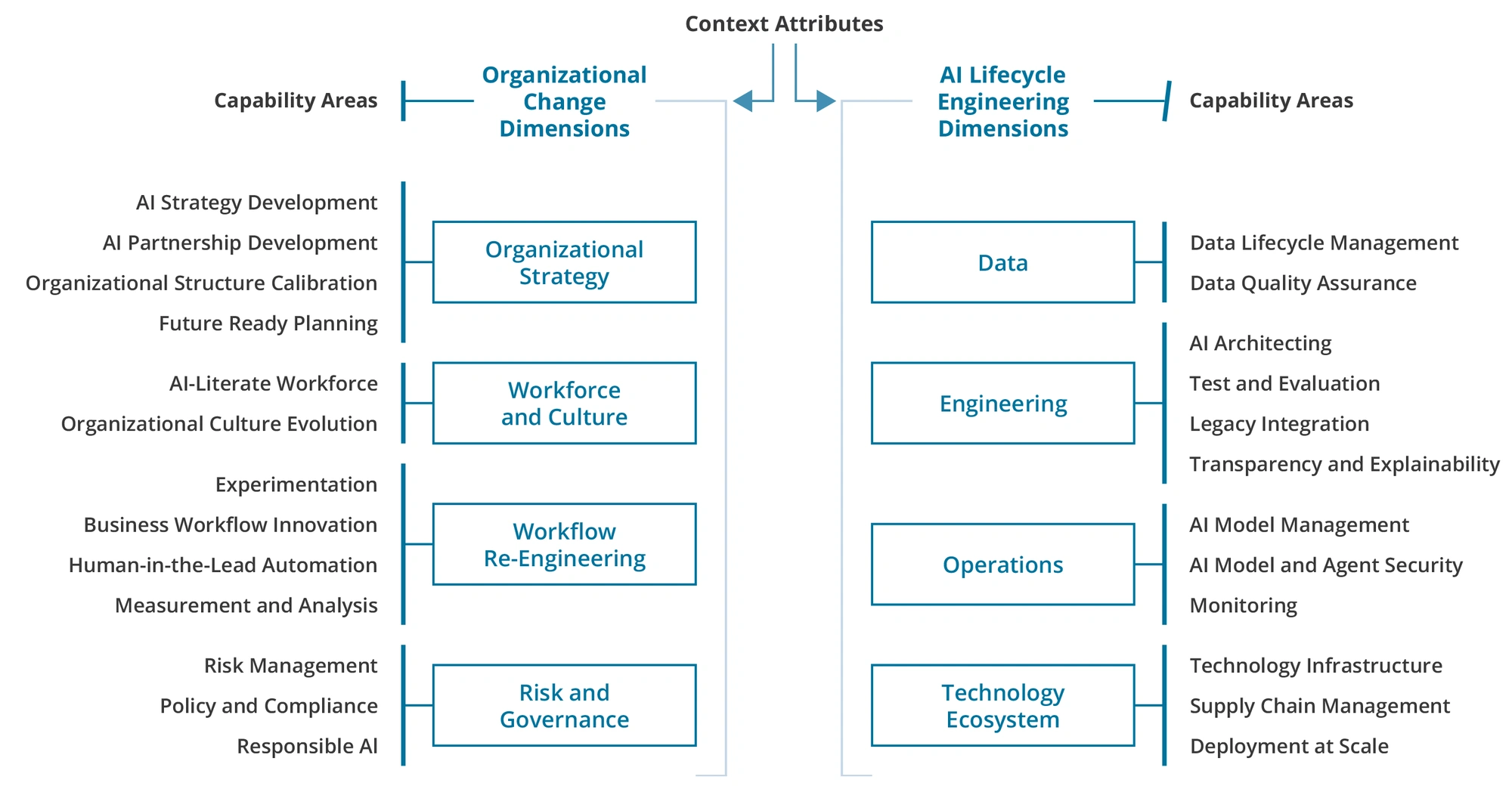
Figure 1: The Eight Dimensions
Organizations can reach different levels of AI adoption maturity. Maturity in each dimension is defined by the following five levels: Exploratory AI, Implemented AI, Aligned AI, Scaled AI, and Future Ready AI. Organizations are assigned maturity levels in each dimension based on how completely they implement the practices within that dimension. These practices set the standard for maturity and, ultimately, for achieving the outcomes that organizations want from their AI adoptions.
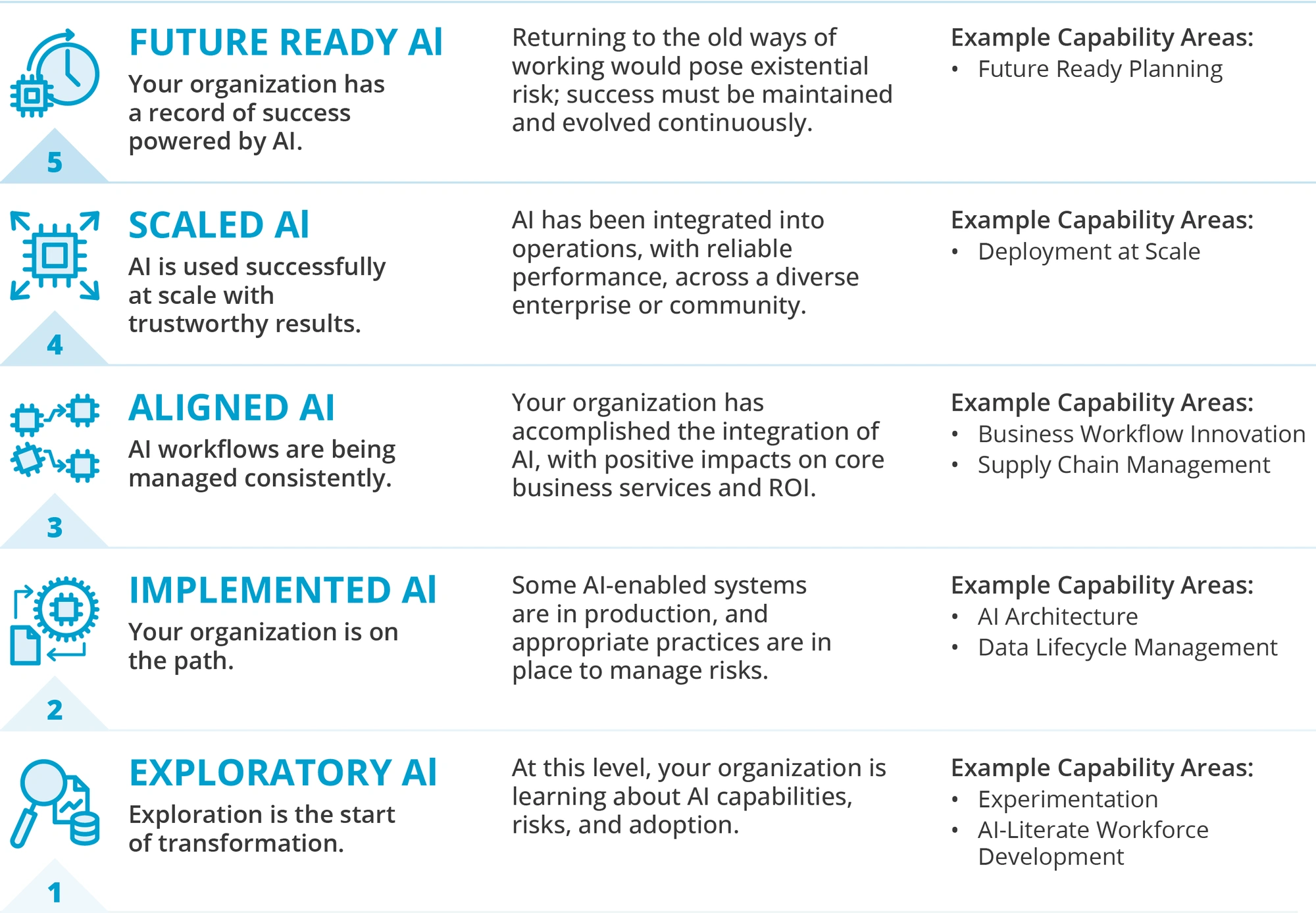
Figure 2: The Five Maturity Levels
The AI Adoption Maturity Model’s early adopter program included several Fortune 500 organizations, and the SEI continues to reach out to the Department of War (DoW) as well as government and industry partners to pioneer the model. The early adopter program delivered demonstrably strong results and proved the effectiveness of the model in accelerating enterprise‑scale AI adoption. Outcomes of the program show that business leaders are citing the model’s results verbatim in boardrooms, thereby directly shaping next‑step priority decisions. As a result, the model is already producing an immediate shift from fragmented organizational AI efforts and churn to a consistent, effective, and forward-looking AI adoption strategy.
Contact us if you want to share feedback or get involved by joining our early adopter program.
Learn More
The AI Adoption Maturity Model v1.0
•Book
Developed by the SEI in collaboration with Accenture, the AI Adoption Maturity Model enables organizations to create an assessment-based roadmap for successful AI adoption.
ReadMaturing AI Adoption: From Chaos to Consistency
•Podcast
Our latest podcast highlights an AI Adoption Maturity Model that organizations can use to create a roadmap for predictable AI adoption and realization of AI benefits.
ListenManaging the Complexities of AI Adoption
•Blog Post
SEI researchers, in partnership with Accenture, studied how organizations can mature AI practices to bring clarity, structure, and consistency to AI adoption. This post outlines our findings.
READFrom Hype to Adoption: Guiding Organizations in Their AI Journey
•Blog Post
The SEI is examining how organizations adopt AI and what methods they can use to measure and improve their adoption for long-term success.
READ