Managing the Complexities of AI Adoption


PUBLISHED IN
AI-Augmented Software EngineeringOrganizations across sectors are undergoing a structural shift as AI solutions redefine operational workflows and challenge traditional execution models. Software-driven organizations are exploring how AI can boost efficiency, productivity, creativity, and value while reducing costs. At the same time, organizations such as OpenAI, Google, Microsoft, and Anthropic are rapidly releasing new versions of frontier models with increasingly advanced capabilities including agentic features and ability to tailor to specific tasks. Two years ago, early generative AI models could barely complete simple cyber tasks. Today, Claude Mythos and GPT-5.5 can autonomously execute complicated multi-stage attacks on vulnerable networks. By the time this text is published, new capabilities of generative AI models will have emerged.
This rate of change requires a shift away in engineering management practices from traditional return‑on‑investment (ROI) calculations and isolated experimentation. Effective AI adoption now demands alignment of business imperatives, disciplined engineering, reimagined workflows and operational processes, measurable outcomes, and continuous improvement mechanisms. Predictable readiness across these areas is essential for keeping pace with technical advancement while managing corresponding risks and governance obligations.
Intentionally defined and systematically managed AI-supported practice maturity is now a critical differentiator for organizational success. Over the past year, SEI researchers, in partnership with Accenture, have studied how organizations can mature their AI practices to bring clarity, structure, and consistency to AI adoption. This post outlines our findings on defining the scope of AI adoption, practical steps for advancing organizational maturity, and outcomes from our joint pilot assessment with Accenture Global IT.
The Challenge of Scoping AI Adoption
Many organizations are pursuing AI adoption with a vague, “AI everywhere” mindset rather than a clearly defined strategy. The pervasive AI‑washing that has saturated nearly every sector—software, telecommunications, transportation, healthcare, automotive, avionics, finance, marketing, and even small local enterprises—has served as a barrier, rather than an enabler. When multiple AI initiatives with different objectives overlap without a clear business direction, it becomes difficult to prioritize value assessment, the supporting practices, and resources needed.
Today, AI adoption may take several forms, each representing a meaningful step toward integrating AI capabilities into an organization. Aspects of AI adoption may include
- implementing vendor solutions that are fundamentally AI‑driven (e.g., AI-assisted integrated development environments (IDEs) or testing agents)
- upgrading traditional vendor tools to new AI‑enhanced versions (e.g., automated meeting summaries or AI-summarized search results)
- re-imagining high‑value business specific use cases with AI-augmentation
- redesigning end‑to‑end workflows to embed AI components and services as integral capabilities that drive new ways of working
- deploying AI platforms or tools that impact multiple workflows within a major business function (e.g., marketing, talent acquisition, or contact‑center operations)
- making an enterprise‑level decision to adopt AI broadly, ensuring the workforce is equipped, enabled, and upskilled to use AI wherever it adds value (e.g., making off-the-shelf frontier models available for general use)
The boundaries among these categories have effectively dissolved due to the ease of integrating generative and agentic AI services into enterprise environments. Importantly, ease of integration does not equate to adoption maturity. Tool usage across the workforce is not, in itself, evidence of AI‑enabled transformation. Successful use of a tool, even by everyone in the organization (e.g., a generative-AI-supported chat), is simply a tool roll out. Gains from tool use can also fluctuate. For example, from 2023 to 2025 productivity gains and usage patterns of experts shifted from a little to significant. AI adoption by contrast, represents a business choice driven by a strategic need with a set of goals that can be effectively addressed by an AI solution.
As AI capabilities proliferate and frontier models continue to advance, organizations are beginning to encounter two major challenges:
1) evaluation of the cost of platform lock‑in, the ongoing operational cost of maintaining and integrating AI capabilities, and the true total cost of ownership associated with enterprise‑scale AI adoption
2) managing a rapidly evolving risk and security landscape in which threat surfaces, assurance requirements, safeguards for sensitive information, and governance expectations are continually shifting
Furthermore, organizations must confront the emerging reality that AI systems are increasingly used to develop, optimize, or govern other AI systems. In this layered and highly dynamic landscape, it is critical for organizations to map their capabilities directly to their AI adoption objectives and define scope for those efforts with precision.
The Carnegie Mellon University SEI AI Adoption Maturity Model, developed in collaboration with Accenture, is designed with explicit awareness of these evolving tiers of AI use. The model reinforces disciplined scope management to address these challenges. Organizations that define target maturity levels and institutionalize the corresponding capabilities and practices are better positioned to apply them consistently across diverse AI initiatives and efficiently adapt them as new AI technologies, capabilities, and use cases emerge.
Developing an AI adoption maturity model amid one of the fastest technological transformations in history presents two challenges: providing structure in a rapidly evolving landscape and balancing guidance with the reality that maturity is not a compliance exercise. We developed the AI Adoption Maturity Model around enduring organizational capabilities rather than transient technologies, viewing maturity as a strategic choice rather than a prescribed destination. The development of the model was grounded in a disciplined, evidence-driven process based on extensive research, including executive interviews, a systematic review of more than a hundred existing AI maturity efforts worldwide, pilots of AI projects, an extensive industry survey, the CMU SEI’s deep expertise in maturity modeling, and Accenture’s global experience with AI implementation. In addition to the maturity model, our review of existing AI adoption maturity models and frameworks will be released in mid-June.
5 Steps to Scoping AI Adoption
Understanding the commitment required for AI adoption and AI maturity in today’s quickly evolving technological landscape is both essential and urgent. AI adoption refers to the systematic integration of AI across business strategy, engineering practices, operational processes, and governance mechanisms. AI maturity reflects the ability to execute these integrations with consistency, scalability, measurable outcomes, and responsible oversight while adapting to rapid technological and risk-related changes.
Until now, the tools and technologies organizations used to build software and operationalize solutions for business-facing services—though diverse—were relatively consistent in their nature and risk profiles. Organizations instead need to consider how AI-enabled initiatives will affect their systems and processes across two critical aspects:
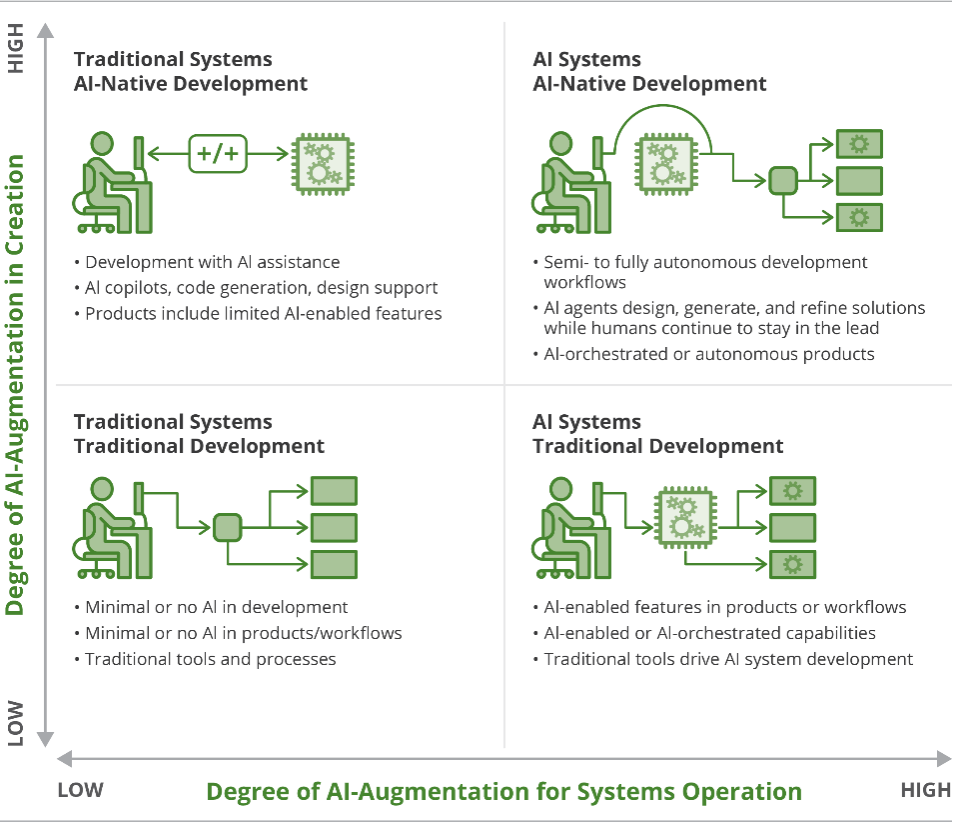
- AI in production: the degree of integration and autonomy of AI during creation and development. This aspect is the degree of AI integration in production (e.g., use of IDEs) and how independently AI-enabled systems operate while generating solutions—ranging from traditional to AI-assisted to augmented, semi‑autonomous, or potentially fully autonomous creation (with a human in the lead in all cases).
- AI in system operation: pervasiveness of AI capabilities in the resulting product or workflow. AI that will be in use in the resulting workflow or product progresses similarly from traditional human‑driven products to AI‑enabled, AI‑orchestrated, and autonomous systems (with a human in the lead in all cases). AI in systems operation may directly support critical services or mission-critical functions in the organization.
Together, these two aspects reveal a rapidly emerging shift in the technological landscape: organizations are entering a space where AI agents are increasingly relied upon for designing, deploying, and managing AI-enabled workflows and products. As a result, the distinction between the tools organizations use (AI as development partner) and the systems they build (AI within the workflow and product) is dissolving, underscoring the essential need for continuous risk management and architectural rigor.
All systems and AI initiatives will soon live in the upper left quadrant in Figure 1. One example would be an AI-powered cybersecurity analyst where AI agents are used to generate synthetic data, develop the platform, monitor and evaluate the outputs, which underscores the criticality of disciplines practice, risk management, and verification and validation. As a result, organizations must manage risks, governance, quality assurance, and dependencies across both dimensions simultaneously. This convergence is one of the key drivers behind the need for AI adoption maturity models as one of the instruments to enable trustworthy systems to be developed with value and ROI.
Ultimately, organizations that succeed in AI adoption balance speed of innovation with engineering rigor, governance discipline, workforce enablement, and continuous learning. The AI Adoption Maturity Model groups these practices into two areas of focus: organizational change and AI lifecycle engineering, with their related dimensions and capabilities. Organizations improve the success of their AI adoption efforts by treating AI as an organizational transformation capability—not simply a technology deployment. Because AI is now embedded both in how software is created and how operational systems deliver value, it must be treated as a critical dependency and potential single point of failure. This reality requires governance approaches that focus more explicitly on the underlying categories of risk, not always controllable by users, which the maturity model helps organizations identify, assess, and manage.
To improve the success of AI adoption efforts and achieve measurable value outcomes amid the rapidly evolving landscape of AI capabilities, leaders in charge of AI adoption should champion the following deliberate steps:
1. Define what AI adoption means for the organization. Organizational and technical leaders often fail to realize that it is not an AI-focused exercise but a business-focused exercise. Leaders must identify opportunities for AI to positively influence the organization by answering the following questions: Why is AI needed to achieve business outcomes? What areas should AI transform? Organizations that fail with AI adoption do not recognize that AI is a means to an end, not the goal. The Organizational Strategy Dimension of the AI Adoption Maturity Model includes capability areas to help organizations make progress in this regard.
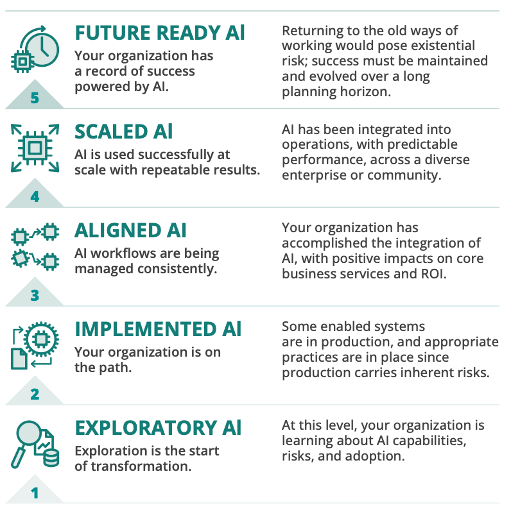
2. Set a target maturity level that is best fit for the organization and its goals. As illustrated in Figure 2 below, the AI Adoption Maturity Model defines maturity across five levels: Exploratory AI, Implemented AI, Aligned AI, Scaled AI, and Future Ready AI. An organization may choose to achieve a lower level (e.g., Implemented AI) for their target maturity to align with business priorities. Most organizations are likely to thrive across Aligned AI, Scaled AI, and Future Ready AI levels of maturity.
3. Assess your current state. Many organizations need nimble instruments to guide them rapidly in the right direction and establish a staged roadmap. This is not a compliance exercise. An evidence-based, yet nimble assessment is critical. Effective maturity improvement requires baselining, identifying milestones, and evaluating progress using qualitative and quantitative evidence. A multi-input consolidation process includes ongoing stakeholder engagement, metrics analysis, tooling data, artifact reviews, and operational outcomes. A singular focus on questionnaires or static governance and compliance checks will not be adequate.
4. Establish foundations. Organizations should establish core capabilities early including governance structures, architectural standards, data and AI lifecycle management, measurement and monitoring practices, security controls, and workforce training. Advancing AI adoption without these foundations often leads to fragmented adoption, operational risk, and unsustainable implementations.
5. Iterate and adapt. AI technologies, risks, and market conditions evolve rapidly. Organizations should adopt incremental implementation roadmaps that allow for experimentation, feedback, recalibration, and continuous improvement while maintaining governance and engineering discipline. The resulting assessment approaches and roadmaps should enable iteration, adaptability, and evolution.
Accenture Global IT Case
Putting any approach to the test is essential in claiming reliable outcomes. We evaluated the effectiveness and use of the AI Adoption Maturity Model first with Accenture’s Global IT organization as pilot zero.
Accenture’s Global IT organization serves a 786,000 global workforce and a diverse set of stakeholders. At the outset of the pilot, Accenture Global IT demonstrated several foundational strengths including a robust technology infrastructure, a mature use case management process enabling rapid experimentation, a training program, and a measurement culture tracking workforce-level AI usage. In testing the AI Adoption Maturity Model, our initial goal was to validate the model in practice while enabling Accenture Global IT to identify the next frontier of AI-driven value creation.
The pilot did not constitute a full, formal assessment. Instead, it served as an experimental validation of whether the AI Adoption Maturity Model could accurately measure adoption and identify areas for further improvement even in a technologically advanced organization.
The pilot validated a pattern in enterprise AI maturity that we had observed in our preparatory research including a survey of more than 600 organizations conducted by SEI and Accenture: organizations can exhibit a strong technical capability while preserving opportunities to strengthen the structural elements required to scale value.
Challenges shared among those surveyed included technical deployments outpacing organizational transformation. While AI systems are becoming operational, cross-functional ownership, oversight, and accountability structures are still being established. As a result, benchmarking and cost transparency are needed to improve ROI tracking and investment decisions. These challenges indicate that while most organizations are transitioning from experimentation to operationalization, they have yet to fully institutionalize the AI practices required for consistent, predictable outcomes and innovation.
The pilot zero assessment demonstrated that Accenture Global IT is a high-performing organization with substantial AI experience and a strong track record of results. At the same time, it surfaced opportunities to more effectively manage the complexity inherent in AI-enabled transformation both within the organization and across its broader ecosystem of practices to fully realize its transformative potential.
Workflow Re-engineering: AI was actively applied to augment workflows, including the use of agentic AI. However, the assessment identified even more workflows that could be redesigned from first principles. In some cases, processes were transformed but lacked evidence of improvement, measurement, and standardization required to progress even further over time.
Value Measurement: Accenture Global IT maintained a measurement culture tracking AI usage, but opportunities were identified where measurements could be improved to capture the full business impact. By documenting cost structures within workflows, the organization could construct rigorous ROI analyses that would evolve over time.
Governance: As an IT function that supports the broader enterprise, the organization operates within a web of cross-functional dependencies. The assessment identified an opportunity to further clarify data ownership in the context of generative and agentic AI, define accountability for AI failure risks, and map dependencies — both upstream and downstream — with greater precision.
These findings identified a specific domain where organizational infrastructure could accelerate the realization of value from the technological adoption. Accenture Global IT has a clear goal: be a top performer and achieve the Future Ready AI level of maturity. The assessment helped them to identify concrete steps towards that goal. The pilot outcomes demonstrated that the primary constraint on AI maturity is alignment across top priority capabilities, such as business workflow innovation, measurement and analysis, and risk and governance structures.
The assessment functioned as a diagnostic instrument, revealing links that were not immediately visible through conventional metrics. This gap represents the boundary between deploying AI and institutionalizing and improving its impact over time.
The results demonstrate that, despite strong technical capability, active AI deployment, and strong adoption in an organizational unit, the assessment could successfully identify opportunities in workflow re-engineering, value measurement, and data governance that could accelerate scaling AI in the organization. These findings suggest that structured maturity assessments continue to provide a reliable mechanism for diagnosing constraints in AI adoption and guiding transformation efforts. The results also suggest that concrete practices in establishing successful AI initiative are still evolving and these instruments assist in clarifying their priorities.
Lessons Learned in AI Adoption
As part of the effort to develop the AI Adoption Maturity Model, in addition to Accenture Global IT, we have completed several pilots and early adopter engagements to ensure the practices in our AI Maturity Model address the most essential areas in AI adoption while maintaining agility and clarity. Through our work on developing the model and its subsequent pilots we learned the following lessons:
- Given the ever-increasing number of AI capabilities infiltrating everything from creation of products to workflows, AI adoption maturity needs to be treated as a continuous goal.
- AI adoption maturity assessments remain essential in this increasingly automation-driven landscape. Successes and failures to meet milestones are often revealed not through written artifacts, but rather the unspoken challenges, implicit assumptions, and omitted requirements uncovered during evaluation and analysis.
- As capabilities of AI services and models increase, the demand to reinvent business and workflows increases and the scope of risk shifts, putting increasing emphasis on capabilities and practices that address risk.
As AI technologies, risks, and business expectations rapidly evolve, organizational leaders must pursue goal alignment, continuous assessment, intentional evolution of practices, and the ability to adapt governance, engineering, and operational approaches. Future posts will detail patterns of gaps and roadmap priorities as we continue to observe early-adopter engagements.
Become an early adopter of the AI Adoption Maturity Model and influence the practice and evolution of AI adoption while getting ahead of AI challenges. To learn more, please send an email to aimm-feedback@sei.cmu.edu.
To learn more about the AI Adoption Maturity Model development journey, register for the June 9 SEI webcast where experts from the SEI and Accenture share technical insights and lessons learned
Additional Resources
Download the AI Adoption Maturity Model: https://www.sei.cmu.edu/library/ai-adoption-maturity-model/
SEI Report: A Preliminary Report on a Model for Maturing AI Adoption: From Hype to Achieving Repeatable, Predictable Outcomes by Ipek Ozkaya, Anita Carleton, Matthew J. Butkovic, Sebastián Echeverría, Robert Edman, John Haller, Erin Harper, Michael D. Konrad, Natalie Schieber, Carol J. Smith, Shawn Wray
SEI Blog Post: From Hype to Adoption: Guiding Organizations in Their AI Journey by Ipek Ozkaya, Anita Carleton, Erin Harper, Natalie Schieber, and Robert Edman
SEI Podcast: Maturing AI Adoption: From Chaos to Consistency with Ipek Ozkaya and Matthew J. Butkovic
Written By



More By The Authors
More In AI-Augmented Software Engineering
An Approach to Accelerate Verification and Software Standards Testing with LLMs
• By Ryan Karl, Yash Hindka, Shen Zhang, John E. Robert
PUBLISHED IN
AI-Augmented Software EngineeringGet updates on our latest work.
Sign up to have the latest post sent to your inbox weekly.
Subscribe Get our RSS feedMore In AI-Augmented Software Engineering
An Approach to Accelerate Verification and Software Standards Testing with LLMs
• By Ryan Karl, Yash Hindka, Shen Zhang, John E. Robert
Get updates on our latest work.
Each week, our researchers write about the latest in software engineering, cybersecurity and artificial intelligence. Sign up to get the latest post sent to your inbox the day it's published.
Subscribe Get our RSS feed