Quantum Navigation: Superposition of Right and Wrong Directions

Quantum sensors have emerged as promising candidates to enhance the sensitivity and availability of navigational systems, specifically in varied underwater environments where classical inertial navigational systems (INSs) and the Global Navigation Satellite System (GNSS) have faced significant challenges. A key driver of early quantum sensor adoption has been the development of smaller, more robust quantum devices that enhance the functionality and accuracy of existing classical navigation systems, one of the most studied uses for quantum sensing.
In this post, we explore sensing in the quantum paradigm with applications in underwater navigation and potential areas of exploration/refinement as part of the collective area of interest known as Quantum Position, Navigation, and Timing (QPNT). To characterize the operational utility of quantum sensors, we will use the following criteria: (1) what is being sensed, (2) the mechanism by which the sensing is done, (3) how it is being used for QPNT, (4) the maturity of the device, (5) SWaP (size, weight, and power), (6) the sensitivity and noise level in the quantum sensor, (7) the conditions required for external signals, (8) limitations of the device, and (9) benefits over classical hardware. Each section will contain a table that describes how one device or one type of device from the section fulfills the criteria listed above. This post will focus on the Quantum Position and Navigation devices of QPNT.
Current State of Underwater Autonomous Navigation
Some of the most technically challenging areas of navigation pertain to autonomous underwater vehicles (AUVs). These vehicles face challenges ranging from degradation of signals and lack of persistent access to the Global Positioning System (GPS), a type of GNSS. As the authors of AUV Navigation and Localization: A Review describe, AUVs instead use dead reckoning to navigate an underwater location through an INS, which reveals data related to the vehicle’s orientation, velocity, or acceleration vector. This information is gathered via classical gyroscopes, which measure the angular rates of a vehicle, and accelerometers, which measure the force required to accelerate a mass. Acoustic sensors, which suffer from short bandwidth, high latency, variable signal speed due to water temperature/salinity, and data loss, only partially supplement these data needs. INS can also benefit from gravimeters, which are a specific type of accelerometer, and magnetometers. In underwater navigation, magnetometers help guide the vehicle around landmarks using magnetic field anomalies that were mapped during previous expeditions. Gravimeters similarly report the strength of Earth’s gravity, which varies at different locations due to terrain features, such as mountains and valleys. When combined with existing gravity maps, the vehicle can use the gravity measurements to navigate. Unlike magnetometers, they require a longer measurement time due to the weakly changing gravitational field.
Unfortunately, dead reckoning errors are cumulative and grow unbounded with distance traveled. INSs are also subject to drift and require frequent recalibration to maintain their accuracy. Classical gravimeters require regular recalibration using a known location, which may be impossible in contested environments or ice-covered waters. Recalibration requires the exchange of information between an external satellite source or an above-water support vessel, which makes integration with an underwater moving vehicle at sea for long periods of time infeasible.
An INS is often paired with a Doppler Velocity Log (DVL) to measure the velocity of both the water and seabed with respect to the AUV. INSs and DVLs can be assisted by deployed infrastructure to act as an external reference, similar to a beacon. However, deploying external infrastructure comes with its own complexity, especially in contested environments. Additionally, according to the authors of Current Trends and Advances in Quantum Navigation for Maritime Applications: A Comprehensive Review, a DVL has more intensive power requirements and requires close proximity to the seabed for consistent locking, a requirement that limits the spatial flexibility of vehicle ranges.
Geophysical systems also provide useful visual odometry for navigational systems. Combinations of visual and inertial sensors systems, called visually augmented navigation (VAM), have already been used to survey the RMS Titanic. VAM has also been used by the U.S. Navy for ship-hull inspection as well as accurate mapping and feature extraction. In underwater environments, the increased susceptibility of scattering, coupled with inadequate lighting, reduces the effective range of cameras.
Quantum navigational systems could address many issues related to the use of navigational systems in underwater conditions. This is due to their intrinsic design, which operates and benefits from the efficiency and sensitivity of quantum-level operations to reduce resource consumption, decrease mission time, and increase mission flexibility. The next section details the operational benefits of quantum navigational systems.
Quantum Sensing and Sensors
The wave nature of matter, quantization, superposition, and entanglement provide the basis for understanding the uniqueness of quantum sensors and their possible advantage over classical sensing equipment. At a quantum-scale level, matter exhibits wave-like properties that can be manipulated to reveal information about the surrounding environment. Quantization at the quantum scale limits observables (e.g., momentum, energy, etc.) to measurable and discrete states that the practitioner can utilize in directly determining how the state of the quantum system reacted to external stimuli. Superposition is a particularly unique quality of quantum mechanics that allows the manipulation of multiple states that define a quantum system. Entanglement is another unique quality that correlates quantum systems spatially separated, allowing them to influence each other from a distance.
These characteristics create the possibility of hardware that measures properties that quantum systems are more sensitive to than classical sensors. Although realized mainly in laboratory settings, quantum sensors have the potential to provide benefits over classical sensors. In their article Quantum Sensing, C. L. Degen, F. Reinhard, and P. Cappellaro describe and provide examples for quantum sensing protocols and the Hamiltonians (mathematical representations) that describe them.
Below, we will describe the different types of quantum sensors that vary in their detection scheme and physical medium that interacts the signals of interest. Their differences offer different levels of feasibility and operational benefit.
Atomic Sensors
Atomic sensors are quantum sensors that use atoms as the probe that interacts with the signal of interest. Their interactions with light are dependent on the signal of interest, making light the way in which the user gathers data regarding the signal. Excluding atomic clocks, which rely on the stable radiation decay of specific elements, atomic sensors exploit sensitivity to electromagnetic and inertial fields. As the authors of Perspective: Practical atom-based quantum sensors explain, different atomic sensors utilize different elements (e.g., rubidium, strontium, cesium, potassium) as well as different atomic configurations within the device (e.g., lattices of trapped atoms through low temperatures or electromagnetic fields, atomic vapors, defects in crystals, and beams of atoms). Atomic sensors are used within INSs to measure inertial motion and implement electromagnetic and gravitational field measurements.
The increased sensitivity of quantum inertial sensors over that of classical underwater INSs, coupled with their lack of reliance on external infrastructure and ability to self-calibrate, could potentially reduce the need to resurface. As an article published by NIST explains, classical tape measures for high-precision applications require calibration after the manufacturing process and throughout its lifecycle. Even then, two tape measures may not be identical. An atomic quantum sensor that uses atoms operates on fundamental constants and processes that have been rigorously verified in multiple experiments. For instance, an atom used in one location will have the same behavior as an atom of the same species in a different location at a different time, adding an intrinsic reproducibility of results and behavior difficult or impossible to achieve classically. Below, we will describe the different uses and types of atomic sensors in the context of navigation.
Atomic Magnetometers
Atomic magnetometers detect magnetic fields by observing the collective behavior of a group of atoms as they interact with the environment. Essentially, this detection occurs when the atoms are bombarded with a type of polarized light that causes them to align along the light’s axis, due to the atoms’ internal structure. The atoms are typically stored as free-moving particles, called an atomic vapor, inside an apparatus that allows light to travel through it. In the presence of a magnetic field, the atoms in the atomic vapor change orientation in a measurable way. The observer can understand the strength of the magnetic field through the difference in orientation. The sensitivity of atomic magnetometers lies in the femtotesla () range per whereas classical magnetometer sensitivities lie in the picotesla () range per .
Put another way, atomic magnetometers can detect magnetic fields that are 1,000 times weaker than a classical magnetometer. The units, “per ,” represent the smallest signal that the quantum device can distinguish in the presence of noise during a one-second measurement. From statistics, we know that if we perform a measurement on N independent parts of a system (like atoms), then the measurement uncertainty (standard error) improves by . The same concept can be applied to the number of measurements we make over some total time. If a measurement cycle takes τ and we repeat it over some total integration time , we get M total measurements where . Thus, we improve our sensitivity by another factor of , meaning noise decreases as . The measurement bandwidth, , is inversely proportional to integration time, T, so the minimum detectable signal scales with . To normalize or account for however other researchers conduct their measurement cycles, researchers divide by . With an atomic magnetometer, we have access to a much smaller signal (femtotesla-range) than the classical magnetometer (picotesla-range) for one second of total data collection.
Sensitivity, which is represented by the units described above and represents the smallest signal the sensor can separate from the surrounding noise, is usually compared to the standard quantum limit (SQL). The SQL is a statistical minimum for quantum noise (i.e., shot noise and backaction) that can be separated from the desired signal in a quantum sensor. The SQL is often treated as a benchmark for statistical potential of specific quantum sensors, given noise and quantum fluctuations. The SQL is typically exceeded when quantum sensing systems utilize entanglement which reduces the statistical dependence from the individual parts (like atoms), reducing the impact of quantum fluctuations on the signal. Giovannetti, Lloyd, and Maccone provide a detailed explanation on how this specific quantum attribute reduces the number of samples needed to achieve a similar error to unentangled systems.
Noise, for both quantum and classical systems, represents background disturbances that could obscure the signal of interest. Noise for both paradigms can be quantified using the same unit scheme described for sensitivity. Table 1 below presents the operational utility of atomic magnetometers to quantum navigation.
Table 1: Operational Utility of Atomic Magnetometers
| Criteria | Atomic Magnetometers |
|---|---|
| (1) Signal of interest | Electromagnetic fields |
| (2) Mechanism | Atomic vapors, atomic lattices |
| (3) Use in Quantum PNT | Measures the Earth's magnetic field, object detection |
| (4) Maturity of the device | Highly developed, offered for sale in industry, more development/demonstration of utility in government |
| (5) SWaP | Chip-size (12.4 x 16.6 x 24.4 mm), < 1kg, ~1 Watt of power (low power) |
| (6) Sensitivity/Noise Level |
Sensitivity: femtotesla (fT, 10−15 Tesla) per
√ range Noise Level: < fT per √ |
| (7) Constraints on external signal | Need existing magnetic field map of Earth (for comparison), measuring at a distance may require shielding of some kind or bias field, thermal feedback loops for environments with changing temperature |
| (8) Limitations | Disruption from noisy equipment/field (ocean waves that produce magnetic fields 100 pT (10−10 Teslas) per √ in magnitude), other uncontrollable noise sources from environment (lightning strikes, solar weather), compounding errors in underlying integrals (post-processing) |
| (9) Benefits (over classical) | Sensitivity (10−12- 10−9 Tesla per √ range for classical magnetometers, self-calibrating, reproducibility of results |
Atomic Interferometers
Atomic interferometers are the main ingredient in quantum inertial sensors, such as accelerometers (gravimeters) and gyroscopes. As the authors of Perspective: Practical atom-based quantum sensors explain, atomic interferometers use the interference pattern resulting from interactions between the matter waveforms of atomic particles to extract information about the field that caused the interference pattern. Waves can constructively and destructively interfere with each other. The resulting interference pattern reveals information about the original waves. This is analogous to optic interferometry where one beam is split in two. Each beam travels in different directions, through different mediums, and then are directed back towards each other. When they collide, the resulting wave has an interference pattern dependent upon the two beams and their path. When one conducts experiments along different acceleration vectors, meaningful information regarding the acceleration can be extracted from the interference patterns. See Current Trends and Advances in Quantum Navigation for Maritime Applications: A Comprehensive Review for a compiled table on the performance of atomic accelerometers, gravimeters, and gyroscopes compared to classical (conventional) versions. Table 2 below presents the operational utility of atomic interferometers in quantum navigation.
Table 2: Operational Utility of Atomic Interferometers
| Criteria | Atomic Interferometers |
|---|---|
| (1) Signal of interest | Interference patterns induced from different quantum states |
| (2) Mechanism | Individually addressable atoms, cold atom vapors, beams of atoms |
| (3) Use in Quantum PNT | Measures acceleration fields |
| (4) Maturity of the device | Highly developed (have been engineered to survive drops from towers and sounding rockets), Cold Atom Laboratory on the ISS is operational with updates/installation from non-specialists, hybrid classical-quantum systems in testing phases, patent-pending variants by NASA |
| (5) SWaP | < 430 Liters (volume), < 320 kg (for example: Laser-cooled atom interferometry, wide power range depending on hardware optimization and environment) |
| (6) Sensitivity/Noise Level |
Sensitivity of Gravimeters: ~1 mGal per √ (navigational models) Noise Level of Gravimeters: 1 nm s−2 per hour (drift) Note on Units: 1 mGal = 10−5 m/s2 (measurement of gravity) Sensitivity of Gyroscopes: ~3x10⁻⁸ rad s−1 per √ Noise Level of Gyroscopes: (1e−6) per hour (drift) |
| (7) Constraints on external signal | Need existing gravity field map of Earth (for comparison), pre-initialization time required, measurement dead/idle times (no data is collected), may require cryogenics depending on hardware configuration |
| (8) Limitations | Larger SWaP, sensitive to control/environmental noise |
| (9) Benefits (over classical) | Sensitivity: Classical gravimeters: 10 - 100 μGal per √, classical gyroscopes remain just as or more sensitive/practical than quantum gyroscopes, state of the art classical gyroscopes achieve 9.7 x 10⁻⁸ rad s−1 per √, low drift (10−6 degrees/hr) vs 0.001 degrees/hr (classically) |
Feasibility of Atomic Sensors
Most experiments involving atomic sensors (and the atomic sensing principles that guide them) are conducted in labs and not in actual varied environments. Outside of strict laboratory environments, quantum inertial sensors are more susceptible to external noise (e.g., vibrations and temperature fluctuations). As Brown and Walker remark, atomic sensors need to be sufficiently insensitive to noise sources to reap the benefits of their low statistical noise. Additional hardware peripherals (e.g., specialized frequency-stabilized lasers, laser cavities, electromagnetic shielding, internal thermal regulation systems, internal controllers) and carefully designed sensing protocols are being developed to mitigate the impact of these noise sources. Researchers are working on balancing the sensitivity specifications with spatial dimension and resource constraints.
Research also notes that the combination of classical and quantum INS would be more efficient in the short term. A hybrid classical-quantum cold-atom atomic sensor was recently tested in a sea trial with a vessel called the Galatea. Researchers collaborating across the University of Strathclyde, Covesion, Trinity House, NLA International, and Innovate UK were able to integrate this quantum sensor into the navigational system that guided the Galatea from Cardiff, UK to Holyhead, UK through 50 mile-per-hour wind speeds. Many other hybrid classical-quantum INSs have been tested in laboratories or simulations. Given their design, most atomic sensors have long enough coherence times (i.e., the duration atomic sensors can maintain quantum data) to extract meaningful results. The authors of Current Trends and Advances in Quantum Navigation for Maritime Applications: A Comprehensive Review predict that atomic inertial sensors will improve navigation for AUVs through increased sensitivity, minimal drift (making them ideal for prolonged missions), and ability to account for classical navigational faults, such as unwanted interference when integrated to create hybrid systems.
Superconducting Sensors
Unlike atomic quantum sensors, superconducting sensors, another category of quantum devices, utilize the properties of metals cooled to a temperature of near absolute zero to observe and detect quantum behavior and its interactions with signals of interest. One of the earliest and most sensitive types, the Superconducting Quantum Interference Device (SQUID), can detect magnetic fields as low as
As the name suggests, this type of sensor relies on interference patterns to extract information about signals of interest. The hardware of a SQUID includes a ring of superconducting wire with two Josephson Junctions inserted in parallel. Without an external magnetic field, the current splits into two branches flowing in opposite directions. When an external magnetic field interacts with the ring, another current is induced to suppress the magnetic flux through the ring. This additional current goes in the same direction as one of the existing two currents. The interference between these currents reveals information about the external magnetic field. Table 3 below explores the operational utility of SQUID in quantum navigation.
In Quantum Sensing, C. L. Degen, F. Reinhard, and P. Cappellaro note that superconducting qubits, fundamental units of quantum information analogous to binary digits in the classical paradigm, have also been the subject of study of quantum sensing. Distinct iterations of qubits include neutral atom, trapped ion, quantum dot, and superconducting qubits. Different types of superconducting qubits, flux and charge qubits, have slightly different hardware configurations and resulting sensitivities to electric and magnetic fields. These qubits are usually integrated into a quantum algorithm to extract the signal of interest from their environment.
Table 3: Operational Utility of SQUID
| Criteria | SQUID |
|---|---|
| (1) Signal of interest | Magnetic fields |
| (2) Mechanism | Interference patterns between induced and present currents from transverse magnetic fields |
| (3) Use in Quantum PNT | Measures magnetic field strength of Earth |
| (4) Maturity of the device | Highly developed, already in use for health applications, navigational activities aboard manned planes and helicopters, nondestructive archaeology, geomagnetic evaluation, nondestructive testing of air- and spacecraft components |
| (5) SWaP | A few cubic meters, ~600 kg, ~7.2 kilowatts (10 |
| (6) Sensitivity/Noise Level |
Sensitivity: Sub-fT per √ Noise Level: 3 fT per √ |
| (7) Constraints on external signal | For navigation, need pre-created magnetic field map of Earth |
| (8) Limitations | Cryogenic temperature requirements and bulky equipment (~77 Kelvin to 86 Kelvin), large size, weight, and power requirements |
| (9) Benefits (over classical) |
Sensitivity (pT to nT (10 |
Feasibility of Superconducting Sensors
Superconducting sensors are already in use for many applications. Spurred by innovation in industry, NASA uses SQUID devices for remote, noncontact sensing of Earth’s magnetic field; tracking the brain activity of pilots; and understanding the navigation patterns of bees.
As expected from their governing superconducting principles, these sensors require rigid environmental requirements such as near-zero Kelvin temperatures to maintain quantum behavior and limit noise. Cryogenic systems attempt to provide this range, but they cost anywhere from $300,000 to $1 million and require a few cubic meters of space, which limits their applicability in unpredictable environments.
Nitrogen-Vacancy (NV) Centers
Given the described limitations and possible benefits of general superconducting and atomic quantum sensors, it is beneficial to highlight a specific sensing platform that fulfills many of the criteria and avoids some of the pitfalls of quantum sensing technologies detailed earlier in this post. Nitrogen-vacancy (NV) centers demonstrate room-temperature-controllable quantum behavior and have been the subject of research for quantum computing and quantum sensing of magnetic and electric fields. Their small SWaP and room temperature operational ability makes them eligible additions to INS for AUVs. NV centers are manufactured in diamonds where a nitrogen atom takes the place of a carbon atom, joined by an adjacent vacancy in the lattice (two missing carbon atoms total). The resulting configuration yields an unpaired electron, which is called the neutral state of the NV center. A negatively charged NV center occurs when another unpaired electron joins the center (creating the necessary spin state). When an external magnetic field interacts with the negatively charged NV center, the spin states of the NV center lose their degeneracy (i.e., the condition where there is no observable difference between the spin states). The difference between these spin states can be measured when the system is illuminated by a laser. The intensity of the emitted light reveals information about the external magnetic field that caused them to gain this difference between their spin states. Table 4 explores the operational utility of NV centers in quantum navigation.
Table 4: Operational Utility of NV Centers
| Criteria | NV Centers |
|---|---|
| (1) Signal of interest | Electric fields, magnetic fields |
| (2) Mechanism | Zeeman effect (separation of degenerate quantum states in the presence of magnetic field) |
| (3) Use in Quantum PNT | Measures magnetic field, in-ensemble can describe magnetic field vector, measures electric field strength, radio frequency parameter detection |
| (4) Maturity of the device | Highly developed, already in use, marketed in industry |
| (5) SWaP | Chip-sized (for emerging compact sensors) / table-top size (laboratory), < 2 kg, milliwatt range (10 |
| (6) Sensitivity/Noise Level |
Sensitivity: Few nanotesla per √ (single NV center) and ~170 pT per √ (numerically proven sensitivity of ensemble NV center configurations) Noise Level: nT per √ (ensemble configuration) |
| (7) Constraints on external signal | Need pre-created magnetic field map of Earth (for navigation) |
| (8) Limitations | Sensitive to noise (stray electromagnetic fields, strain in the atomic lattice, photon noise from lasers), optically driven requires initialization (optical pumping), decent sensitivity (compared to other quantum sensors) |
| (9) Benefits (over classical) | Cheaper, smaller, portable |
Feasibility of NV Centers
Unlike superconducting and some atomic sensors, NV centers do not require cryogenic temperatures. They are also relatively compact, transportable, and robust. While they remain sensitive to external noise, Debuisschert describes how these sensors can work individually (to get strength of magnetic field) or in an ensemble (to get direction of magnetic field), reducing the constraints on scaling. Existing applications include mapping Earth’s magnetic field and monitoring space weather. Given their abilities and benefits, NV centers are being studied as possible additions to space missions that involve gathering data about the magnetic fields present on planets. They are also being studied as possible sensors that can be integrated into navigational systems. Two studies (see here and here) detail an interesting application that involves detecting and analyzing radio frequency signals via their interaction with NV centers.
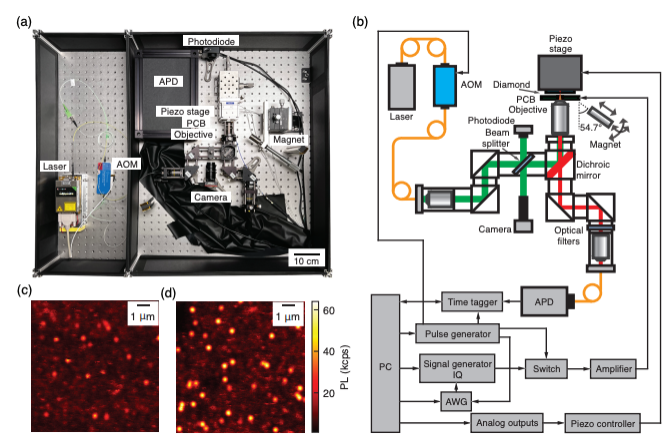
NV center systems, like the ones found in university labs, can cost between $68,000 and $100,000. Figure 1 provides a visual representation/schematic of a typical laboratory NV center system. The scale on Figure 1 demonstrates the compactness of this quantum system.
Quantum Imaging/Detection
Quantum imaging, a subfield of quantum optics, utilizes quantum entanglement and photonics to improve image resolution, contrast, and spectral range. This area offers efficiency in spectroscopy and imaging in spectral ranges that classical optical sensors have not yet achieved or may find impossible to achieve. Within the context of navigation, the authors of Current Trends and Advances in Quantum Navigation for Maritime Applications: A Comprehensive Review assert that quantum imaging could assist in geophysical protocols that rely on image comparisons for localization within an environment. For underwater navigation, quantum imagining is especially attractive, as theoretical results suggest potential performance improvements, particularly in low-light conditions, and the ability to surpass the shot noise limit, which constrains the classical imaging schemes.
Ghost imaging, an application of quantum imaging, involves optical correlations between two entangled photons. One photon, the idler, must interact with an object before it can be measured while the other photon, the signal, is measured directly. Even though the signal photon does not interact with the object of interest, it can be processed with the idler photon that did interact with the object to offer feature information for imaging. The image or profile forms as the positions of the idlers that hit the detector are saved. This only occurs when the signal’s detection is coincident to the idler. As photon detection is binary, the image represents a cross-sectional slice of the object. This method can help generate images of objects outside the direct line of sight and/or in low light. Table 5 explores the operational utility of ghost imaging in quantum navigation.
Table 5: Operational Utility of Ghost Imaging
| Criteria | Ghost Imaging |
|---|---|
| (1) Signal of interest | Visual information |
| (2) Mechanism | Entangled photon correlations |
| (3) Use in Quantum PNT | Geophysical imaging, out of line-of-sight imaging, creation of better optical maps for visual-based navigation |
| (4) Maturity of the device | Predominantly demonstrated in laboratory experiments, more development focused on improving hardware |
| (5) SWaP | 600 mm x 1200 mm x 58 mm, 31 kg – 80 kg, milliwatt range |
| (6) Sensitivity/Noise Level |
Sensitivity: Exceeds the standard quantum limit (or shot noise limit) via sub-shot noise imaging Noise Level: Sensitive to thermal and sensor noise but can be systematically eliminated under certain constraints |
| (7) Constraints on external signal | Need synchronicity of detectors in contested environments |
| (8) Limitations | Viable demonstrations in laboratory settings only, photon loss, entangled photon generation, the image generated is a cross-sectional profile without specific object details, scattering within hardware, mode crosstalk, bulky, alignment sensitive |
| (9) Benefits (over classical) | High resolution in low-light conditions, exceeds shot noise limit seen in classical schemes |
Feasibility of Quantum Imaging
Some of the main concerns regarding quantum imaging and detection lie in the challenges and unpredictability from limited, real-world testing. These schemes are mostly theorized and tested in controlled laboratories where synchronization between photon detectors is more achievable. Laboratory experiments involve bulky equipment and setups that are incompatible with field-deployability. Recent research focuses on creating filters called metasurfaces that can manipulate the properties of the photons that interact with (or pass through) them to preserve their coherence (i.e., ability to maintain quantum information) and improve overall image visibility for compact configurations. When applied to quantum imaging, metasurfaces were shown to improve correlation contrast for photons and reduce mode crosstalk. In this area, current research includes developing a more flexible metasurface configuration that reacts more favorably to uncharacterized environmental noise. A partnership between the QuantIC team at the University of Glasgow and the National Physical Laboratory, UK is exploring the characterization of metasurfaces, specifically their ability to influence photon coherence, expanding quantum imaging to include the use of undetected photons and cheaper equipment.
Beyond the Classical Limits: Collapsing in the Right Direction
Quantum mechanical properties have only relatively recently shaken the foundations of physics. By changing our understanding of reality, quantum mechanics has also offered us new ways to interact with our reality. The new ways offer a closer glimpse of the most fundamental of particles, signals, and systems, offering a richer and more accurate view of how natural systems behave.
Quantum sensors, sensors that use these fundamental behaviors and particles to understand the natural world, have a wide range of capability in regimes that rely on accurately measuring signals such as Earth’s magnetic and gravitational field for navigation. Through their reliance on fundamental particles, we achieve a reproducibility not capable in classical devices while also leaving behind many of the external calibration devices required for accuracy in classical navigational systems. We also achieve high sensitivity to signals of interest through quantum properties, such as superposition and entanglement, which are unavailable in classical navigational systems.
Quantum sensing platforms develop at different rates and come with their own strategic advantages and disadvantages due to their design and method of detection. Quantum sensors like atomic magnetometers and NV centers are already actively used in field experiments and measurement campaigns for underwater navigation. They represent the active research, development, and progress in this space and what is hopefully to come for the other quantum devices with lower technology readiness levels (TRL). SQUID devices, achieve an unparalleled level of sensitivity for detecting magnetic fields, but require costly resources to maintain this advantage. Quantum imaging can achieve stealth and unmatched resolution in low-light conditions, but their limited tests in contested environments restrict their applicability. With every gain in one category, there is loss in another. As the field continues to develop, this may become less of a balancing act. To work with us in exploring applications of quantum navigation, please reach out to us at info@sei.cmu.edu.
Written By

PUBLISHED IN
Quantum ComputingGet updates on our latest work.
Sign up to have the latest post sent to your inbox weekly.
Subscribe Get our RSS feedGet updates on our latest work.
Each week, our researchers write about the latest in software engineering, cybersecurity and artificial intelligence. Sign up to get the latest post sent to your inbox the day it's published.
Subscribe Get our RSS feed